Français
  Português
  עברית
עברית  Español
  Svenska
  日本語
日本語  繁體中文
繁體中文  Denmark
 Norway
 German


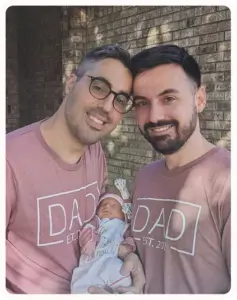


What research says, what families feel at home, and how to turn it into everyday practice
Dozens of studies in developmental and family psychology consistently indicate: the strongest predictor of children’s well-being is not blood relation, but the quality of parenting and the couple’s relationship. In families with two fathers (or two mothers) where only one parent is genetic, no differences were found in children’s functioning or in the strength of attachment to the non-genetic parent, when there is equal parenting, full legal regulation, and open communication about birth origins.
What the research says
- Relationship quality outweighs genetics.
Prof. Susan Golombok (Cambridge) summarizes decades of research on “new families”: “The quality of relationships at home matters more than the way the child came into the world.” Her studies and those of other researchers found no harm to the well-being of children born via donation/surrogacy compared with their peers in heterosexual families – when parenting quality is high. - Parental cooperation predicts well-being.
Farr, Forssell & Patterson (2010–2016) showed that variables such as cooperation between parents, fair division of roles, and social support are strong predictors of children’s adjustment—far better than any biological variable. - The first year of life: temporary gaps.
Studies by Carone, Baiocco & Lingiardi (2018–2021) in surrogacy-based two-father families found that during the first year the genetic parent may sometimes engage slightly more in care, but the gap decreases over time and does not predict a weaker bond with the non-genetic parent. - Early transparency = less conflict.
In the literature on gamete donation (Ilioi et al., 2017; Golombok, 2020), gradual, age-appropriate disclosure of the birth story is associated with greater child self-confidence and fewer tensions in adolescence. - Differences in behavioral indices.
Broad reviews (e.g., Fedewa et al., 2015) show no significant differences in behavior, adjustment, and academic performance between children of same-sex parents and children in different-sex families – when emotional and material resources are similar.
When and how to tell a child who the genetic parent is?
Guiding principle: Research on gamete donation and surrogacy consistently shows that early, gradual, age-appropriate transparency is linked with less conflict and greater identity security in adolescence. A “secret” kept for years tends to undermine trust when revealed later.
Suggested timelines
- Ages 0–2: Begin with a simple, positive story during everyday moments (“There were kind people who helped bring you into the world”). No need to explicitly mention “who is genetic” – the emphasis is on love and having two full parents.
- Ages 3–5: Add basic details: surrogacy/donation and what that means. If relevant, you can say: “One of us provided the small part from which the body begins to grow (the genes), and both of us are fully your parents.”
- Ages 6–9: Briefly explain genes and heredity in simple terms. Answer direct questions about “who is genetic” factually, without dramatization, and stress that parenthood is defined by love, responsibility, and shared life.
- Ages 10–12: Invite discussion of feelings around the topic, curiosity about the donor/surrogate, and privacy rights. You can also prepare together for questions at school and from friends.
- Adolescence: A mature dialogue about identity, origins, access to documents/databases (if they exist), and mutual agreement on privacy boundaries with others/social media.
*The ages listed here are approximate only and depend on each child’s individual psychological development.
Communication principles
- Positivity and consistency: Always tell the story with pride and respect for everyone involved.
- Not a “one-off” but a process: Revisit the story at deeper levels as the child grows.
- Parental equality in language: Avoid terms that create hierarchy (“real/biological”). Use: “One of us contributed genes, and both of us are parents in every sense.”
- Right to know + right to privacy: The child decides whom to tell outside the family and when.
- Organized documents: Keep a family file (parentage/guardianship orders, thank-you letters to the surrogate/donor, journey photos) – open it together when the child asks.
Short answers to common child questions
- “Whose am I?” – “Ours. One of us contributed your genes, and both of us are your parents every day.”
- “Why did you do it this way?” – “It was the safest and best way to bring you into the world.”
- “Can I meet/know more?” – “We’ll check together the laws/agreements and decide together what’s right for you and for us.”
When not to wait?
- When there is a chance the child will find out from an external source (friends or relatives, social media, DNA tests, etc.). In such cases, a calm and immediate parental initiative helps preserve trust.
When to seek professional help?
- When there are disagreements between partners about timing/wording, or if the child responds with prolonged anger/confusion. Brief counseling with a developmental psychologist/LGBTQ+ family specialist can provide personalized language and a gradual plan.
Sample phrasing (adapt as needed)
- For a child aged 4–6:
“There are many ways to make a family. For you to come to us, we got special help. One of us gave the part your body starts growing from – those are called genes – and both of us are your parents in every way.” - For a child aged 8–10:
“Genes are little instructions inside the body. In our family, one of us contributed your genes. It doesn’t change how much we are parents – both of us are 100% your parents, and we’re here for everything.”
What does it feel like at home? Possible effects and responses
- Sense of “belonging” of the non-genetic parent.
It’s natural to have thoughts or worries early on. Consistent bonding – skin-to-skin, feeding, bedtime routines, and similar activities – melts gaps.
Tip: Set a weekly “one-on-one” time for each parent with the baby. - Social expectations and awkward questions.
Questions like “Whose baby is it?” can be unsettling. A unified message from both parents – “We are both full, responsible parents” – protects the family unit. - Division of roles.
In the early months, a “spontaneous” split may arise based on who’s on leave/available. It’s important not to cement a hierarchy based on biology.
Quick tools: Weekly task board; rotating night duties; tracking “who did what” to balance. - Child identity and future questions.
Children are naturally curious about their origins. When the story is told early, simply, and proudly, they internalize a stable family identity. - Legal and insurance arrangements.
Early parentage/guardianship order, meticulous registration of both partners with all authorities, medical powers of attorney, and appropriate insurance reduce daily anxiety and prevent reliance on “biology” in dealings with institutions (schools, HMOs, hospitals, airports, etc.).
Recommended practices for same-sex couples
- Establish fixed bonding rituals for each parent (bath, bedtime, feeding, stroller walks).
- Consistent family language: avoid hierarchies (“real/biological”). Say: “Two parents, equal responsibility.”
- Birth story – early, positive, and age-appropriate. Expand gradually.
- Complete legal regulation promptly (parentage order/second-parent adoption per local law) and update insurance/beneficiaries.
- Build a support network: family, friends, gay-parent groups, brief counseling as needed.
- Nurture the couple relationship: regular couple time, agreements on workload sharing, a monthly “situation room” for logistics.
Frequently asked questions
- Do children “prefer” the genetic parent?
No. Attachment research shows that bonds are based on consistent responsiveness and emotional safety – not on genetics. - What about adolescence?
Curiosity increases; when there is a history of transparency, conflict is lower and the search for information occurs from a place of security, not a denial of family identity. - Should we decide in advance who will be the genetic parent “based on who cares more”?
The main considerations are medical/genetic/age-related. Emotional balance is built through equal caregiving, not through “biological priority.”
In conclusion
In same-sex couples where only one parent is genetic, the day-to-day meaning of parenthood is determined not by genetics but by presence, responsibility, and love translated into action. With full legal regulation, equal caregiving, and open communication, both parents’ bond with the child is strong, and children grow up with security, thriving, and family pride.
*This blog summarizes research findings and general clinical principles and does not replace personal (legal/therapeutic) advice. If unique questions arise, professional consultation experienced with surrogacy-based families is recommended.